
304 Stainless Steel
304 is a widely available general-purpose austenitic stainless steel with good corrosion resistance and an attractive finished appearance. It suits durable structural parts, housings and connectors. It is less free-machining than 303 and generally less resistant to chloride attack than 316.
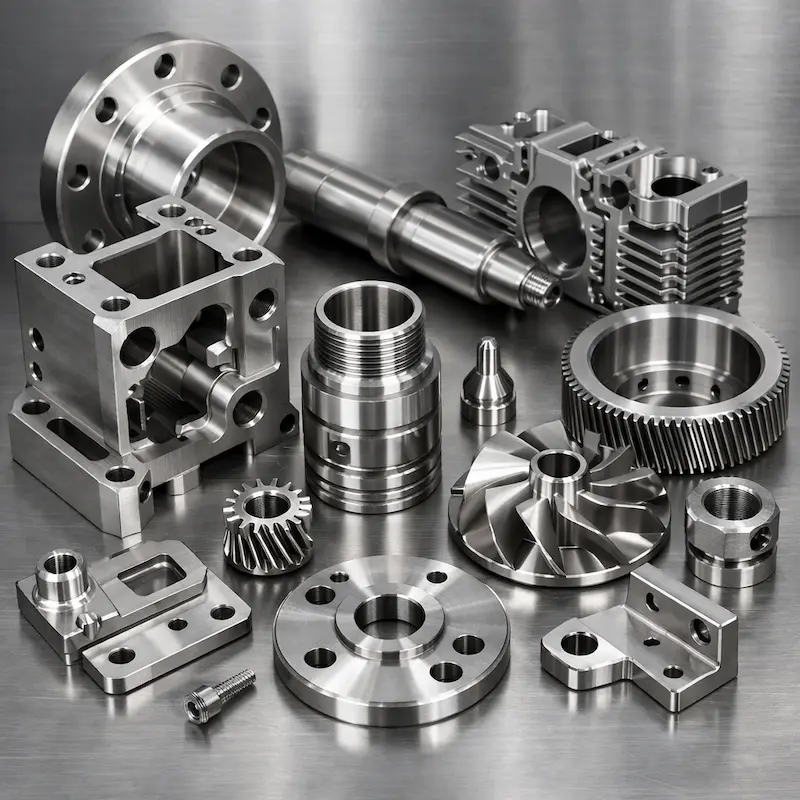
Typical Applications
Use for cosmetic and structural components, connectors, housings and corrosion-resistant end-use parts. Consider 316 or 316L for chloride exposure, 303 for production turning efficiency, or heat-treated 410 or 420 for hardness and wear resistance.
Reference Properties & Manufacturing Parameters
Reference values are indicative and are not guaranteed specifications. Material grade, stock condition, processing, test method and part geometry can change the result. A listed temperature is not a continuous-use rating.
| Dimensional tolerance | Confirm during drawing review |
|---|---|
| Minimum wall thickness | 1.0 mm |
| Reference temperature range | 800 °C |
| Reference tensile strength | 520–750 MPa |
| Reference density | 7.93 g/cm³ |
- Properties depend on the specified grade, material condition and manufacturing route. Confirm the required condition, service temperature and inspection criteria during engineering review.
Finishing Options
Confirm compatibility with the exact material grade and application. Define cosmetic surfaces, coating thickness, masking and any dimensional or performance requirements before manufacture.
Design & Manufacturing Review
- Provide a 3D CAD model and a dimensioned 2D drawing identifying critical tolerances, datums, threads and fits.
- Review thin walls, deep cavities, internal corner radii and tool access. Material condition and workholding affect distortion and achievable tolerances.
- Define cosmetic surfaces and masking requirements. Coating thickness may affect dimensions and assembly fits.
For a quotation, email CAD files, drawings, material requirements, quantity and target delivery date to [email protected].