
Polycarbonate (PC)
Polycarbonate combines toughness, high impact resistance, useful heat resistance and transparency for protective guards, impact-resistant housings and structural parts. It is tougher than PMMA but generally less scratch resistant. CNC machining requires cutting-heat control to reduce residual stress and cracking; polishing can improve the appearance of transparent edges. It is suitable for cosmetic prototypes and functional validation.
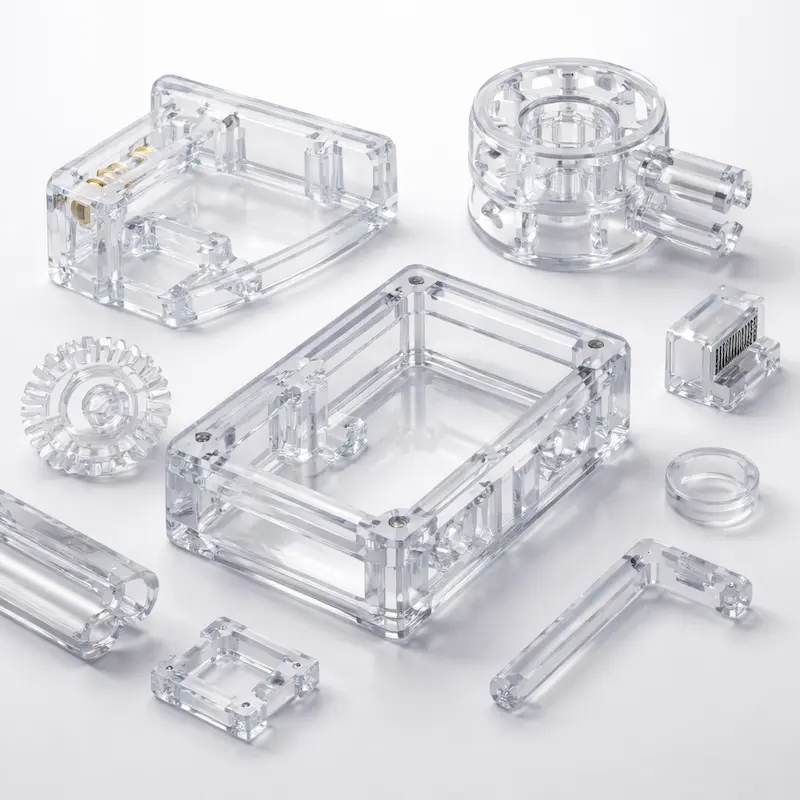
Typical Applications
Transparent guards, impact-resistant housings, inspection windows in fixtures, structural parts and assembly-validation components. Consider PMMA for optical clarity and surface hardness, PPS or PEEK for demanding chemical or thermal environments, or painted ABS for lower-cost cosmetic parts.
Reference Properties & Manufacturing Parameters
Reference values are indicative and are not guaranteed specifications. Material grade, stock condition, processing, test method and part geometry can change the result. A listed temperature is not a continuous-use rating.
| Dimensional tolerance | Confirm during drawing review |
|---|---|
| Minimum wall thickness | 2.0 mm |
| Reference temperature range | 120 °C |
| Reference tensile strength | 60–70 MPa |
| Reference density | 1.20 g/cm³ |
- Reference values vary with grade, material condition, part geometry and manufacturing process. Confirm final specifications during drawing review.
- Temperature figures are source reference values; the test method, loading and exposure duration are not specified and must be confirmed for the application.
- The source tolerance has no unit; no dimensional tolerance is inferred.
Finishing Options
Confirm compatibility with the exact material grade and application. Define cosmetic surfaces, coating thickness, masking and any dimensional or performance requirements before manufacture.
Design & Manufacturing Review
- Provide a 3D CAD model and a dimensioned 2D drawing identifying critical tolerances, datums, threads and fits.
- Review thin walls, deep cavities, internal corner radii and tool access. Material condition and workholding affect distortion and achievable tolerances.
- Define cosmetic surfaces and masking requirements. Coating thickness may affect dimensions and assembly fits.
For a quotation, email CAD files, drawings, material requirements, quantity and target delivery date to [email protected].