
Polyether Ether Ketone (PEEK)
PEEK is a high-performance engineering thermoplastic combining heat and chemical resistance, strength, dimensional stability, wear resistance and fatigue performance. Compared with PPS, it can offer greater toughness and performance in demanding applications, at a higher cost. CNC machining supports precise features and good surface quality for aerospace, medical, semiconductor and industrial equipment components. Suitability depends on the specified grade and service conditions.
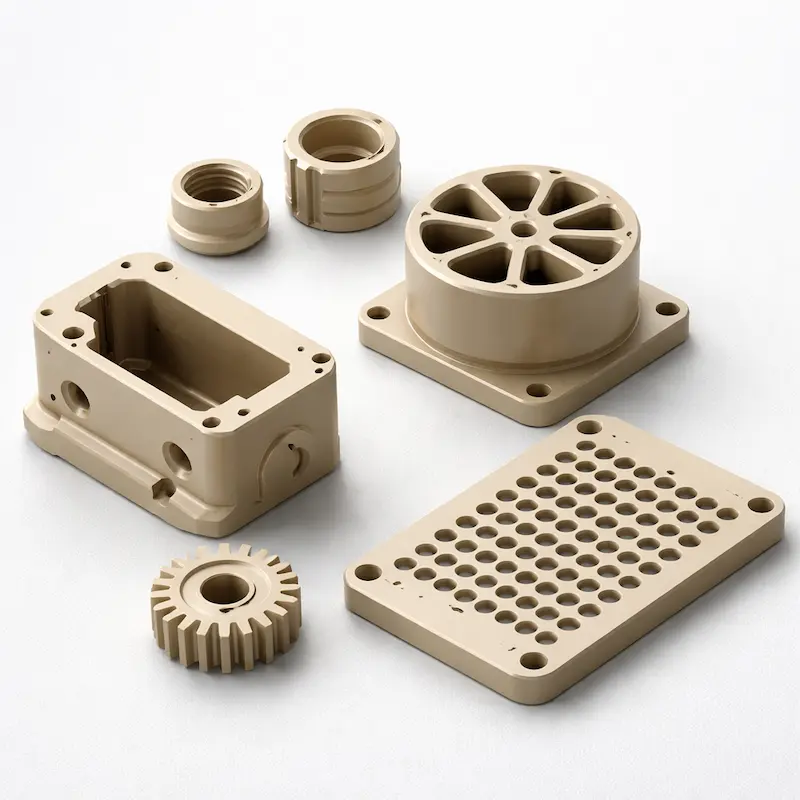
Typical Applications
Heat- and chemical-resistant structures, insulating parts, wear components and precision functional parts for semiconductor, medical or aerospace equipment. Consider PPS when requirements permit a lower-cost option, PA or PC for lower temperatures, or PTFE for low-friction sealing where lower mechanical strength is acceptable.
Reference Properties & Manufacturing Parameters
Reference values are indicative and are not guaranteed specifications. Material grade, stock condition, processing, test method and part geometry can change the result. A listed temperature is not a continuous-use rating.
| Dimensional tolerance | Confirm during drawing review |
|---|---|
| Minimum wall thickness | 1.5 mm |
| Reference temperature range | 250 °C |
| Reference tensile strength | 90–100 MPa |
| Reference density | 1.30 g/cm³ |
- Reference values vary with grade, material condition, part geometry and manufacturing process. Confirm final specifications during drawing review.
- Temperature figures are source reference values; the test method, loading and exposure duration are not specified and must be confirmed for the application.
- The source tolerance has no unit; no dimensional tolerance is inferred.
Finishing Options
Confirm compatibility with the exact material grade and application. Define cosmetic surfaces, coating thickness, masking and any dimensional or performance requirements before manufacture.
Design & Manufacturing Review
- Provide a 3D CAD model and a dimensioned 2D drawing identifying critical tolerances, datums, threads and fits.
- Review thin walls, deep cavities, internal corner radii and tool access. Material condition and workholding affect distortion and achievable tolerances.
- Define cosmetic surfaces and masking requirements. Coating thickness may affect dimensions and assembly fits.
For a quotation, email CAD files, drawings, material requirements, quantity and target delivery date to [email protected].