
PA6 Nylon
PA6 nylon is an engineering thermoplastic with toughness, wear resistance and moderate cost. It suits lightweight functional parts, sliding components and assembly structures. Moisture absorption can affect machined dimensions; drying, conditioning and machining allowances should be specified accordingly. PA6 generally offers good toughness and machinability, while PA66 is often selected for higher stiffness and temperature requirements.
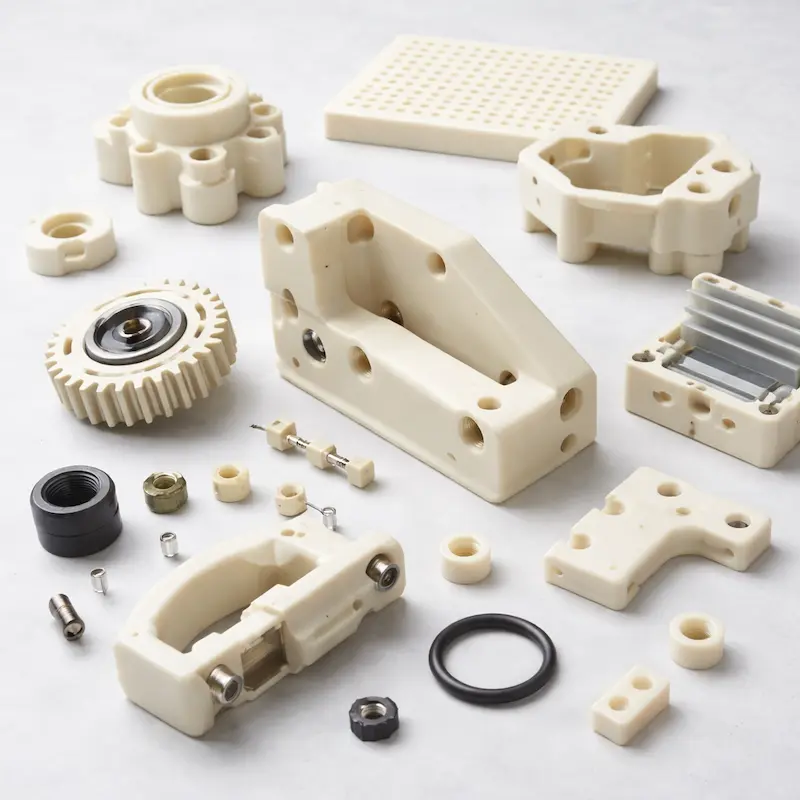
Typical Applications
Slides, guides, lightly loaded gears, washers, bushings, nonmetallic fixture contact parts and lightweight structures. Consider PA66 or PEEK for higher temperature and stiffness requirements, POM or PTFE for low-friction applications, and POM or PEEK when moisture-related dimensional change is a key concern.
Reference Properties & Manufacturing Parameters
Reference values are indicative and are not guaranteed specifications. Material grade, stock condition, processing, test method and part geometry can change the result. A listed temperature is not a continuous-use rating.
| Dimensional tolerance | Confirm during drawing review |
|---|---|
| Minimum wall thickness | 1.5 mm |
| Reference temperature range | 100 °C |
| Reference tensile strength | 60–80 MPa |
| Reference density | 1.13 g/cm³ |
- Reference properties depend on the supplied grade, condition and test method. Confirm the required material specification before ordering.
- The listed temperature is a catalog reference, not a guaranteed continuous-service limit; assess load, duration and environment for the application.
- The source does not state units for the tolerance value. Confirm dimensional tolerances during drawing review.
Finishing Options
Confirm compatibility with the exact material grade and application. Define cosmetic surfaces, coating thickness, masking and any dimensional or performance requirements before manufacture.
Design & Manufacturing Review
- Provide a 3D CAD model and a dimensioned 2D drawing identifying critical tolerances, datums, threads and fits.
- Review thin walls, deep cavities, internal corner radii and tool access. Material condition and workholding affect distortion and achievable tolerances.
- Define cosmetic surfaces and masking requirements. Coating thickness may affect dimensions and assembly fits.
For a quotation, email CAD files, drawings, material requirements, quantity and target delivery date to [email protected].